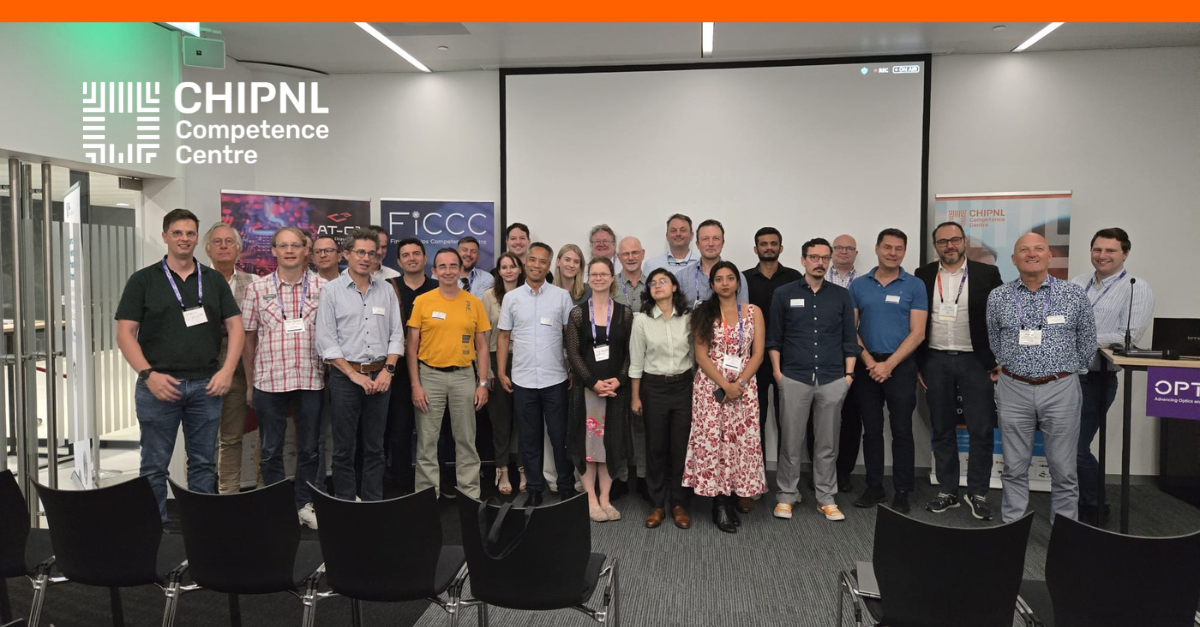
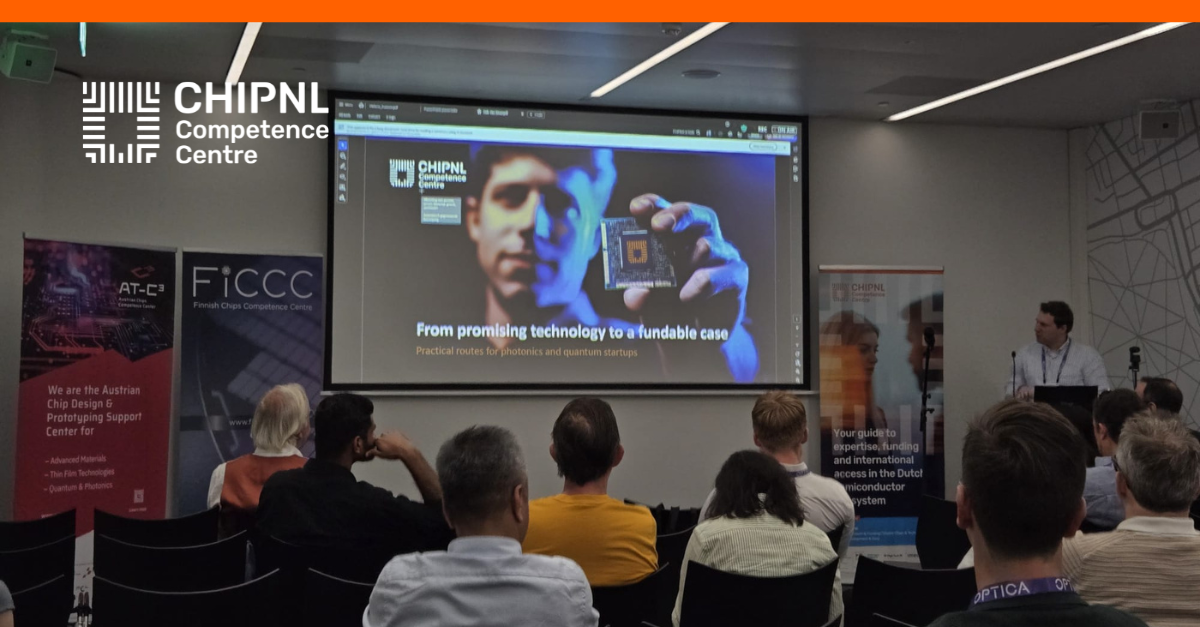
On July 17, 2026, more than 40 startups, SMEs, researchers, and investors gathered at MECC Maastricht for the workshop Quantum Photonics for Startups & SMEs. The meeting took place during the Optica ImageSense Congress and was a joint initiative of ChipNL CC, the Finnish Chips Competence Centre (FiCCC), and the Austrian Chips Competence Center (AT-C3). Central was a question shared by many participants: how do you turn promising technology in photonics and quantum into a fundable growth trajectory?
Three countries, one issue
The workshop was a concrete example of collaboration within the European network of Chips Competence Centres, the network established under the EU Chips Act and the Digital Europe Programme. ChipNL CC, FiCCC, and AT-C3 each brought their own ecosystem and expertise, but shared the same mission: to support startups and SMEs in photonics and quantum on their way to market and funding.
Borislav Hinkov (Silicon Austria Labs / AT-C3) explained how the CHAMP-ION pilot line provides companies with direct access to production processes for photonic chips and how AT-C3 has been working on a turnkey service for Austrian and European companies since January 2025. Tomi Salo (Kvanttinova / FiCCC) shared how Finland is building its semiconductor strategy: from €1.6 billion in 2024 to a targeted €5-6 billion in 2035, with photonics as a key focus in sectors such as sensing, imaging, and quantum. Finnish companies like Varjo, Dispelix, and Modulight demonstrate that this ambition has already taken root.
Photonic integration: roadmap and access
Martijn Heck (Eindhoven University of Technology) outlined the European roadmap for integrated photonic circuits and the role of the JePPIX platform, which provides SMEs and startups with access to European foundry capacity for photonic integrated circuits (PICs). Through JePPIX, companies with limited budgets can have a chip designed and manufactured, lowering a significant barrier.
Peter-Jan Hendrikx (Casimir Institute / TU/e), Jyrki Saarinen (University of Eastern Finland), and Helene Hainzer (University of Vienna / VCQ) shared insights on quantum sensing and applications in precision measurement technology. Ronan Gourges (Single Quantum) presented how single-photon detection is now breaking through in quantum communication, medical diagnostics, and space applications.
ChipNL CC also explained the TNO Quantum Sensing Testbed and the Quantum Application Lab as the Dutch infrastructure that companies in the ecosystem can connect to.
From technology to fundable project
One of the most concrete sessions was by Dirk van Meer (ChipNL CC - Oost NL) on funding pathways for photonics and quantum startups. He introduced four pathways that companies can take, depending on their stage and type:
- R1: Adoption and prototyping
- R2: Collaborative R&D
- R3: Single-company de-risking
- R4: Venture capital
Van Meer emphasized that the route should match the ambition, not the other way around. His central message: "Technology becomes fundable when the next risk is clear, the right partners are in place, and the route matches the ambition." Current opportunities he mentioned included: Chips JU Photonics & ECS calls, Eurostars Call 11, PhotonHub PHACTORY, and national instruments under the Chipsact 2.0.
Participants were encouraged to leave the day with two potential partners, one chosen route, and a concrete milestone plan for the next ninety days.
European context
The workshop in Maastricht illustrates how the European network of Chips Competence Centres works in practice: nationally rooted, but European connected. By giving FiCCC and AT-C3 the stage together, participants could not only learn from the Dutch situation, but also from the approach and success stories from Finland and Austria. This exchange of knowledge, networks, and funding insight is precisely what the CCC network aims for.
Role of ChipNL CC
ChipNL CC connects startups and SMEs in the photonics and quantum sector with knowledge, production platforms, and financing routes, both nationally and across Europe. Through JePPIX, ChipNL CC provides access to photonic integration platforms; through the aCCCes network, joining European partner programs and other Chips Competence Centres is possible. The Quantum Photonics workshop demonstrates how ChipNL CC fulfills that connecting role in practice: by bringing together parties with a shared issue on an international stage.
Do you want to work with photonics or quantum as a startup or SME? Contact us via www.cccnl.nl